
The Mission
At OrbitClear, we are pioneering a solution to the escalating issue of micro space debris, which poses significant risks to satellites, space stations, and future space missions. Our approach involves deploying CubeSats(via share riding) equipped with expandable adhesive membranes designed to capture and safely remove micro debris from Earth’s orbit. This method is both cost-effective and environmentally responsible, ensuring the sustainability of space operations. By focusing on micro space debris, we aim to safeguard orbital environments and support the continued growth of space exploration and commerce.
Source : OrbitClear Original Animation
Source : OrbitClear Original Animation
Credit :Tokyo Institute of Technology
Hiroshi Furuya Lab
Technical Specifications
OrbitClear Mission 1(M1) Product Overview
Specification
Type : Space debris mitigation system
Base Unit : 27U CubeSat
Internal Units : Contains 27 deployable 1U CubeSats
Purpose : Capture and remove micro debris (≤5cm)
Physical Dimensions
Component Size (cm) Surface Area (m²) Weight (kg)
27U CubeSat 30 x 30 x 34 - ~45 kg
Each 1U CubeSat 10 x 10 x 10 1 m² membrane (expanded) ~3 kg per unit
Fully Deployed System 27 m² total membrane 27m² ~81kg (all 27 units)
Operational Parameters
Parameter Details
Orbital Altitude 500–1,200 km (low Earth orbit) High density regions
Target Debris Size 1 mm to 5 cm
Debris Collection Capacity 0.5–1 kg per 1U CubeSat per mission
Total Capacity 13.5–27 kg of debris captured per 27U CubeSat mission
Mission Duration 3-6 months (depends on debris density and operational altitude)
-
Deployment and Features
Feature Details
Adhesive Membrane Deployment 27 individual membranes (1 m² each), designed for optimal debris capture
Navigation Navigation system for targeting high-density debris zones
Deorbiting System Drag sail and cold gas thrusters used for controlled atmospheric re-entry
End-of-Life Plan Fully burns up upon reentry, leaving no residual debris
Mission Specifications
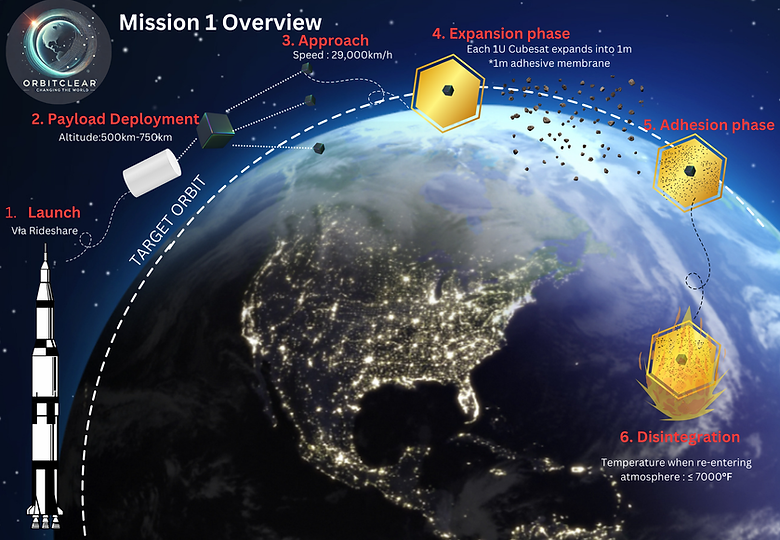

OrbitClear’s Mission 1 has six phases:
1. Launch: The 27U CubeSat is deployed into Low Earth Orbit via a ride-share launch, reaching an altitude of 500–750 km.
2. Payload Deployment: The 27U CubeSat releases 27 individual 1U CubeSats into their designated orbital paths.
3. Approach Phase: The 1U CubeSats, traveling at speeds of 29,000 km/h, use navigations to enter high-density micro-debris zones.
4. Expansion Phase: Each 1U CubeSat deploys a 1m² adhesive membrane, designed to capture micro-debris passively.
5. Adhesion Phase: The membranes collect debris particles as they pass through the targeted high density orbital regions.
6. Disintegration: Once the mission is complete, the adhesive membranes act as drag sails, guiding the CubeSats and collected debris safely into Earth’s atmosphere, where they burn up at temperatures exceeding 7,000°F, leaving no trace. Cold gas thrusters are used on higher altitudes
OrbitClear is currently in the Research and Concept Development phase of its mission timeline. The team is focused on finalizing the conceptual designs for the 27U CubeSat and its deployable 1U units while conducting feasibility studies to identify the most effective materials for the adhesive membranes. Partnerships with research institutions and space agencies are being pursued to support prototype testing and further validate the system’s capabilities in preparation for the next phase.

Financial Projections

Cost per mission : 1.258 million USD
* Costs are projected to decrease due to development of cheaper ride share launch options